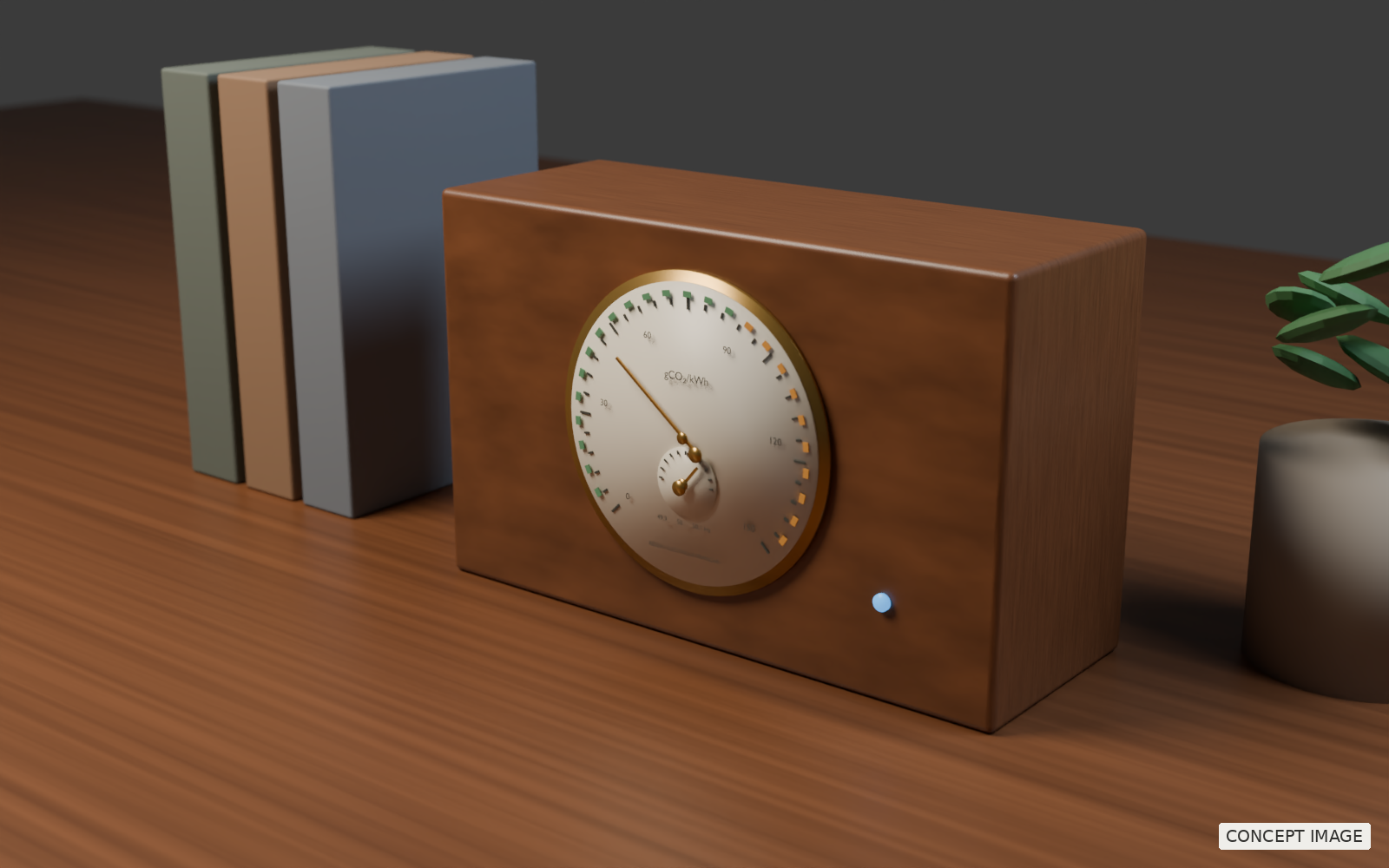
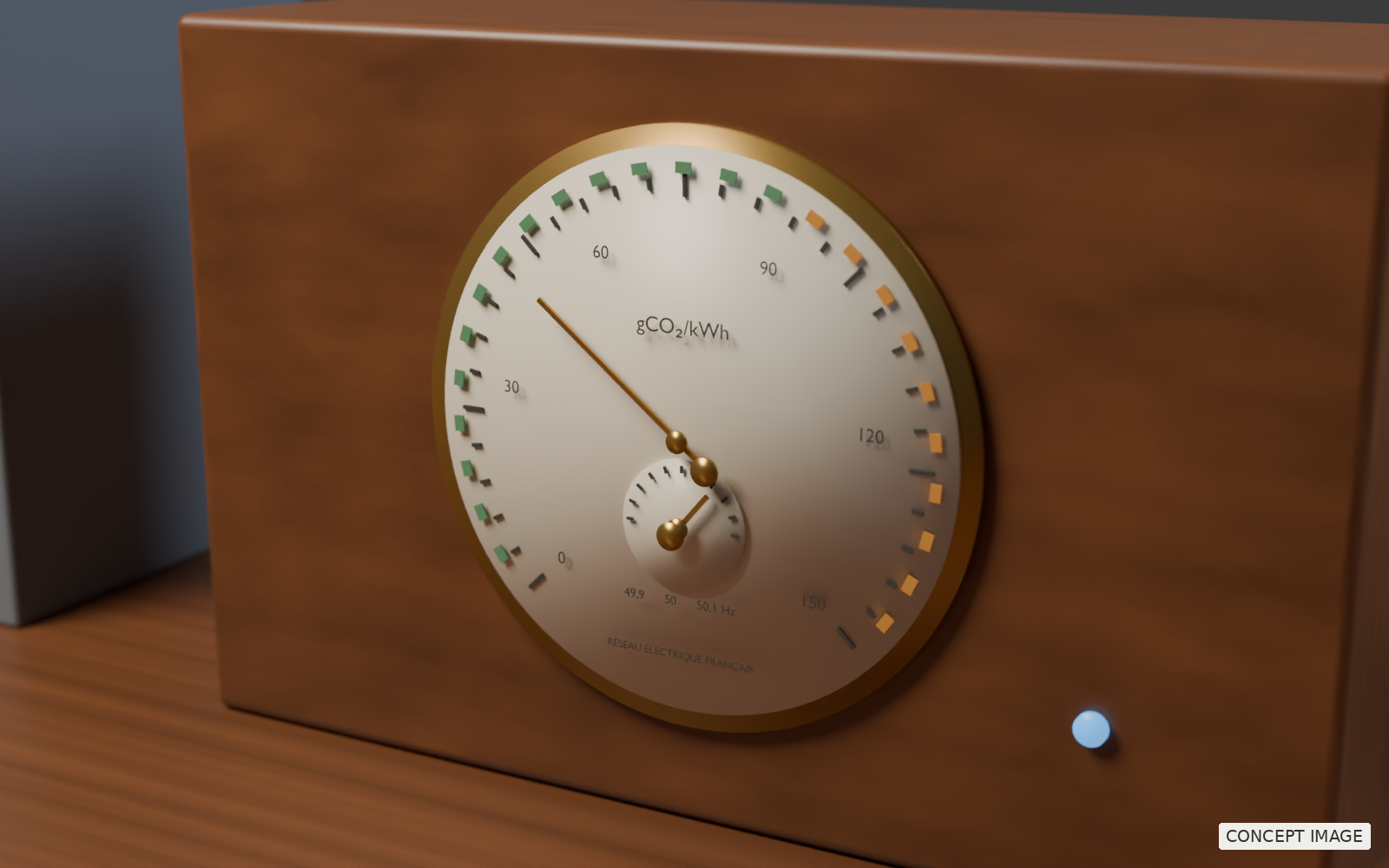
Is it real?
Both measurements are real: RTE publishes the carbon intensity of French production every fifteen minutes under an open licence, and grid frequency can be measured from any socket with simple electronics. The product, however, does not exist yet. The pictures are renders, the case is being designed, and I have not built a working prototype. The €1 reservation is how I find out whether it is worth building.
What if it never ships?
Then you get your euro back, automatically and without asking. If too few people reserve, or the prototype cannot reach the quality I want, or the campaign does not fund, there will be no campaign charge and no product, and every reservation is refunded to the card that paid it. You will hear about it by email either way.
Is the carbon figure my socket?
No, and it matters to say so clearly. The large needle shows a national estimate, calculated by RTE from electricity production in France; it is the same figure in Brest and in Strasbourg, and it is neither a measurement of the current reaching your home nor your personal footprint. It also leaves out electricity imported from neighbouring countries. The small needle, on the other hand, really is measured at your socket, by the object itself. If RTE's data stops arriving, for example when the Wi-Fi is down, the large needle returns to rest rather than show a stale figure.
Why does the frequency needle move?
Because production and consumption are never exactly equal. All the generators in continental Europe turn together at the same speed, and when we use a little more than we produce they slow down very slightly: the frequency drops by a few thousandths or hundredths of a hertz until reserve plants make up the difference. The movements are often visible on the hour, when many plants change their production schedule at the same time. If a large generating unit trips somewhere in Europe, you will see it on the small needle.
Do I need an app, an account or Wi-Fi?
You need Wi-Fi for the large needle and the lamp, but no app and no account. The first time you plug it in, the object opens a small temporary Wi-Fi network; you join it with your phone, pick your home network on a web page, and that's it. I plan for it to read RTE's public data directly, without depending on a server of mine, so it keeps working even if I disappear. The small needle works with no connection at all.
Is it safe? Is the case connected to 230 V?
No, there is no 230 V inside the wooden case. It is powered by a low-voltage adapter that plugs into the socket, like the one for a router or a speaker, and that sealed, certified adapter is what isolates the object from the mains. It uses about as much power as a night light (to be confirmed on the prototype). It will carry the CE marking before it is sold.
Does it work outside France?
The small needle works wherever the grid runs at 50 hertz, so across continental Europe, with an adapter for that country's socket. The large needle and the Tempo lamp show French electricity, because they come from RTE's data. A version for other countries is not planned for the first batch.
Why €149 to €179?
The case is machined from solid walnut, the needles are brass and the gauge movements are real needle instruments, assembled in a small batch of 50 without moulds, which costs more per piece than a plastic object made by the thousand. A Wi-Fi object also has to pass radio and safety testing before it can be sold, and that cost is spread over very few units. I'll publish the price once the first quotes are in, and reservers get the lowest one.